

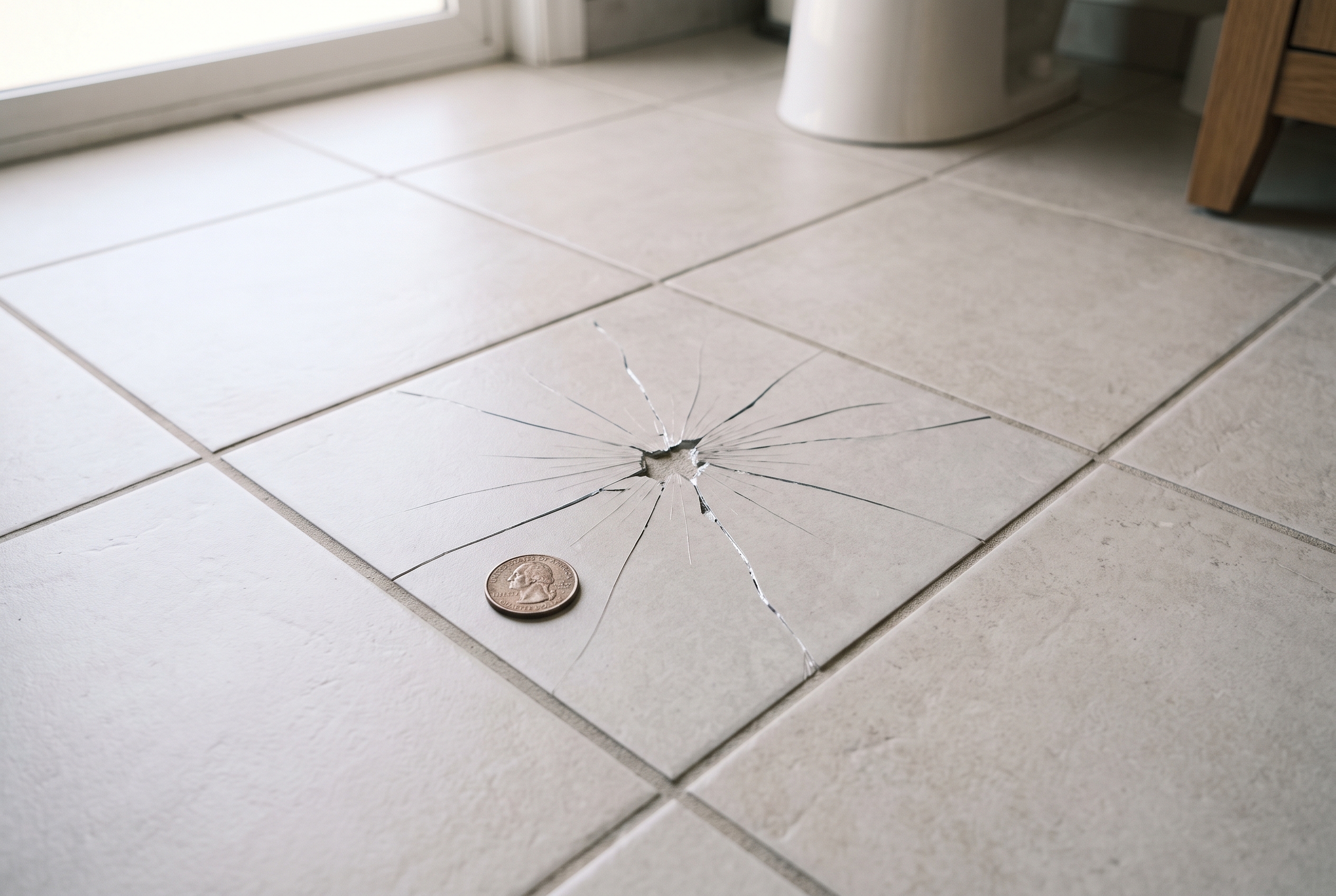
Floor tile cracks or comes loose when something pushes on it harder than it can take: a dropped pan, a floor that flexes, a slab that cracked, or a floor with no room to expand. When the cause was a one-time blow over a sound floor, one new tile fixes it for good. When the damage points to the floor under the tile, the bond or missing movement joints, a repair only buys time.
One cracked tile, with the crack spreading from a chipped spot, almost always means something hit it. If the tiles around it sound solid, replacing that one tile is a lasting fix.
Cracks running through several tiles in a line mean the floor underneath moved. It is usually a crack in the concrete, or a seam or joist under a wood floor, and new tiles laid over the same spot will crack along the same line.
Hollow-sounding or loose tiles, often with grout crumbling in the walking paths, mean the tile is losing its grip. A few hollow tiles over a slab can be watched. Loose tile spreading across a wood floor usually means taking the area up and relaying it.
Tiles lifting in a ridge, sometimes with a loud crack, mean the floor had no room to expand. That area has to be relaid with movement joints.
The damage itself usually tells you which of those you have.
| What you see | Likely cause | Repair or redo |
|---|---|---|
| Starburst crack from a chipped spot | Something dropped on it | Replace the one tile |
| Straight crack across several tiles | Slab crack, or seam or joist under it | Fix the floor, then retile |
| Crack with one side higher | Settlement | Check the structure first |
| Soft spot or cracks by a toilet or tub | Leak and rotting subfloor | Stop the leak, repair, retile |
| Hollow tiles, loose grout in traffic lanes | Failing bond or flexing floor | Relay the affected area |
| Tiles lifting in a ridge | No room to expand | Relay with movement joints |
| Grout cracked only at walls or tub | Grout where caulk belongs | Rake out, caulk the joint |
| Cracked grout, tiles still solid | Grout mix or packing | Regrout the joints |
How to Read the Cracks in a Tile Floor
Tile has no give, so a crack is a record of where the pressure came from. Its shape, how many tiles it crosses and what is happening nearby narrow down the cause before anyone lifts a tile. Start by stepping back and asking whether the damage is one tile, one line or one area.
One Crack That Starts From a Single Point
A crack from a dropped object spreads out from where it hit, and the center is usually chipped or crushed. It stays in one tile, and the tiles around it sound normal when you tap them with a coin. This is the one kind of damage where the floor did nothing wrong.
Tap the cracked tile itself too. If it also sounds hollow, there may have been little mortar under that spot, and the dropped jar may simply have found a weak tile. Check the rest of the floor for hollow spots before you settle on a one-tile repair.
Cracks That Run in a Line Across Several Tiles
A crack that runs straight through several tiles, right across the grout joints, is following something underneath. On a concrete slab, a crack in the concrete reflects up through the tile bonded to it. A saw-cut control joint that was tiled over does the same. On a wood floor, a line of cracks usually sits over a joist, a seam in the plywood, or a stretch where the floor flexes more than tile allows.
In older houses with a subfloor of individual boards, tile set without a plywood layer on top tends to crack along the board seams, because each board moves on its own.
Replacing the cracked tiles alone will not hold, because whatever moved is still there. Over a slab, the lasting repair takes the tile up along the crack and sets new tile over a crack isolation membrane, a thin layer that stretches so the movement never reaches the tile. Over wood, the floor has to be stiffened or the subfloor repaired first.
Does Cracked Tile Mean Foundation Problems?
No, not usually. Most cracked tile comes from impact, the floor under the tile or the way it was set. Settlement becomes the likely cause when the cracks come with other signs. Look for one side of a crack sitting higher than the other, gaps opening between the tile and the wall, or grout pulling apart across a wide area. If a crack in your tile has one edge higher than the other, have the structure looked at before any tile is replaced.
Soft Spots and Cracks Near a Toilet or Tub
Cracked tile around a toilet, tub or shower, especially where the floor feels soft or has begun to sag, can mean water has been getting under the tile and the wood is rotting. As the wood softens, the floor gives, and the tile over the worst spot cracks first. Gaps at the base of the wall or split caulk often come with it.
A slow leak at a toilet seal can go on for years before it shows on the surface. The order of work matters: find and stop the leak, cut out and replace the damaged subfloor, then retile. Regrouting or replacing a few tiles on top of wet, soft wood only hides it. A moisture meter shows how far the damage has gone, since wood that stays over about 25 percent moisture is in the range where rot takes hold.
Why Floor Tiles Sound Hollow or Come Loose
A tile sounds hollow when there is a void under it, and it comes loose when the mortar lets go of the tile, the floor or both. The usual reasons are thinset spread too thin or in dabs, or thinset used after it had started to set. Paint, sealer or old adhesive left on the subfloor keeps mortar from gripping, too.
A subfloor that flexes or has been damaged by water, and a floor with no movement joints, loosen tile more slowly. Each of those leaves the tile sitting on less mortar than it needs, and every footstep works it a little looser. Loose tiles then knock against each other and the floor, which is how a hollow tile often turns into a cracked one.
Do Hollow Tiles Need to Be Replaced?
No, not always. A tile can sound hollow and still be bonded, and over a concrete slab that doesn't flex, a few hollow tiles held by their grout can go years without trouble. Over a wood subfloor it is more serious, because movement there tends to break the grout away and loosen the tile the rest of the way.
Cracked or missing grout around a hollow tile is the sign to act. Once grout starts to crumble in a walking path, the tiles there are usually loose, and tiles that sound fine today may follow if the same problem sits under them. Our advice is to map the hollow spots with a coin before deciding anything. A handful scattered over a slab is a floor to watch; a cluster that keeps growing is a floor to relay.
Tiles Popping Up or Tenting
When tiles lift off the floor in a peak, often with a bang loud enough to hear from another room, the floor ran out of room to expand. Tenting is a classic sign of missing or too few movement joints. Over concrete, the slab keeps shrinking slightly as it cures, which squeezes the tile, and sun or heat through a big window adds to the pressure.
It can happen years after the floor went in. The pressure builds slowly, and how long the tile holds depends on how fast the slab shrinks, how strongly the thinset grips and how much heat the floor sees. A poorly bonded floor tents early; a well-bonded one can hold for years before it lets go.
Keep people and pets off the lifted area, since the edges can be sharp and loose tiles can shift. Pressing or gluing the tiles back where they were leaves the pressure that lifted them in place. The lasting fix is to take up the tented tiles and the ones around them and clean the floor. The area is then relaid with a soft joint at the walls and, on a large floor, joints through the field of the tile.
Cracked Grout Between Floor Tiles
Cracked grout is either a grout problem or a floor problem, and the tiles tell you which. If the tiles around the cracks are solid and don't rock, the grout was probably mixed too wet, not packed all the way into the joint, or worked after it had started to set. If the tiles sound hollow or move, the floor is flexing, and the grout is just the first thing to show it.
Grout that cracks only where the floor meets a wall, a tub or a cabinet is a different case. Those joints should hold flexible caulk, because the surfaces on either side move independently, and grout there cracks and lets water in behind it.
New grout spread over cracked grout has nothing to hold on to and soon cracks again. A proper regrout removes at least two-thirds of the old grout's depth before the new grout goes in. In a bathroom, or anywhere the floor gets wet, don't leave cracked grout for long, because it lets water reach the mortar and the subfloor.
When a Single-Tile Repair Works
Replacing one tile is a lasting repair when three things are true: the damage came from a one-time impact, the tiles around it sound solid, and you have a matching tile. When all three hold, the new tile will outlast the memory of whatever was dropped.
The grout around the tile is cut out first, and the cracked tile is broken out with a hammer and chisel, with eye protection on. The old mortar is scraped off down to the floor, and the new tile is set in fresh thinset level with its neighbors. After the thinset sets, usually overnight, the joints are grouted.
A fine hairline crack in a tile that isn't loose can be filled instead of replaced. Clear or tinted two-part epoxy worked into the crack seals it and makes it much harder to see, and it needs about a day before it takes weight. It is a cosmetic fix, and it only makes sense when the crack came from a single knock.
Matching a Tile You Can't Buy Anymore
Finding a match is often the hardest part of a tile repair. Tile colors shift slightly from one production run to the next, and patterns get discontinued. The best answer is spare tile from the original job, which is why we recommend keeping about 10 percent extra from any new floor.
Without a spare, there are three good options. A tile can be borrowed from a spot no one sees, such as under the refrigerator or in a closet, and that spot filled with the closest match. A few tiles in a deliberate pattern can be replaced with an accent tile so the repair looks planned. Or the floor can be replaced up to a natural break, such as a doorway, so the new tile only has to match itself.
When a Repair Isn't Enough
A repair isn't enough when the cause is still under the tile. New tiles set over a flexing floor, a moving crack, a rotting subfloor or a floor with no movement joints will crack or loosen again, sometimes within months.
These are the signs that the floor, and not just the tile, needs the work:
- Cracks that run across several tiles, or come back after tiles were replaced
- Hollow or loose tiles spreading from one area into the next
- Grout crumbling along walking paths
- A floor that sags, feels soft or bounces
- Tiles that have tented or lifted
- Water damage around a toilet, tub or shower
Can Epoxy Injection Fix Loose Tiles?
Yes, for a few tiles and for a while, but it doesn't fix the cause. Epoxy injected through the grout joints can re-stick a small patch of hollow tile. The Tile Council of North America calls it impractical over a large area and warns that a repair that ignores the cause may not last. The injection rarely reaches every void, either, and the neighboring tiles are still sitting on the same problem.
What Redoing the Floor Involves
Redoing a failed area means taking the tile up, fixing whatever caused the failure, and setting new tile the way it should have been set the first time. Depending on the cause, that can mean stiffening the floor, replacing water-damaged subfloor, adding a crack isolation membrane over a slab crack, putting in movement joints, or all of them.
Sometimes the damaged area is small enough to relay with matching tile. Often a new floor from wall to wall is the better value, especially when the tile is discontinued or the problem runs through the room. It also lets you choose a tile you love instead of the closest match you can find.
Cracked Tile Floors and New Tile at Rodrigues Flooring
At Rodrigues Flooring, we fix the part of a tile problem that a patch can't reach: the floor underneath. Our services include subfloor repair, so water-damaged or flexing subfloor is put right before new tile goes down, and we install tile floors for homes and businesses across South Jersey from our Moorestown showroom.
If your floor needs new tile, you can browse our porcelain and ceramic tile from Chesapeake Flooring, Dal Tile and Tesoro before you visit. We are a family business run by three brothers, with more than 20 years in flooring and licensed installers.
Cracked and Loose Tile Questions We Hear Most
How Long Should a Tile Floor Last?
A properly installed tile floor should last as long as the house it is in. So when tile on a fairly new floor cracks or comes loose, look at the floor under it and the way it was set before blaming the tile.
How Much Does It Cost to Replace a Cracked Floor Tile?
The cost depends far more on why the tile cracked than on the tile. Swapping one impact-cracked tile for a spare from the original job is a small repair. Matching a discontinued tile, relaying a hollow area, or fixing the subfloor under it turns the same crack into a bigger job, and sometimes into a new floor.
Is a Cracked Floor Tile Dangerous?
Yes, it can be. Cracked tile can have sharp edges that cut bare feet and paws, and a loose piece can shift underfoot. In a bathroom or kitchen, cracked tile and grout also let water into the floor, so cover the spot or keep traffic off it until it is repaired.
Can You Tile Over Cracked Tile?
No, not over tile that cracked because the floor moved. Tiling over old tile only works when the old tile is well bonded and sound, because the new tile depends on everything underneath it. If the old floor cracked from movement, the new one will crack the same way.
How Do You Keep a New Tile Floor From Cracking?
Start with a floor stiff and flat enough for tile, and put the right backing over it. Get thinset under at least 80 percent of every tile with all the corners supported, and leave movement joints at the walls. Those four prevent almost every tile failure, and spare tile from the job covers the rest.
Find Out What Is Under Your Cracked Tile
A cracked tile is really a question about the floor under it. If you'd like us to take a look, book a free in-home estimate. We'll check the damage, tell you whether the floor needs work, and show you the options for new tile if it's time.


