

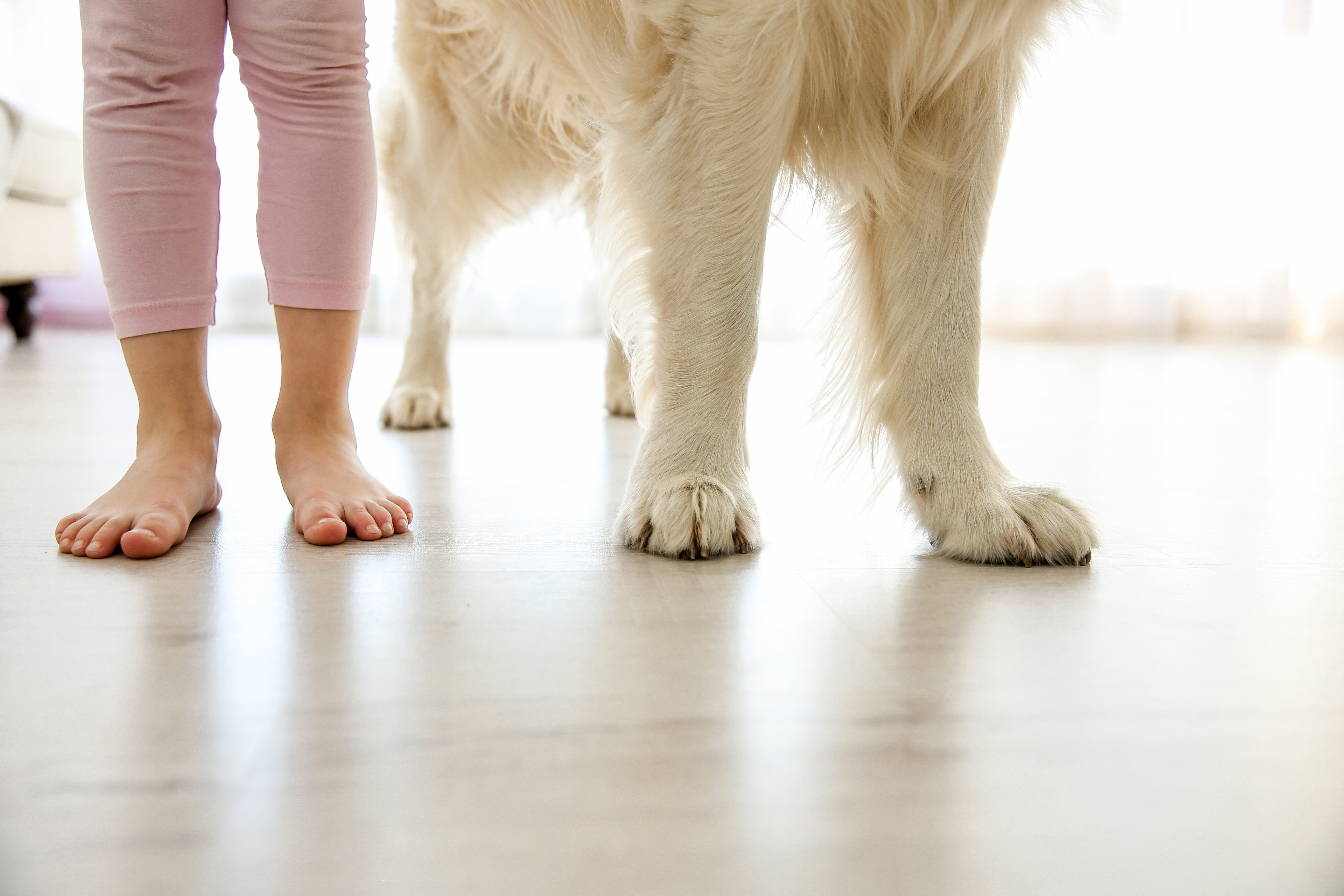
A wood floor makes two kinds of noise, and each one is fixed in a different place. The clicks, echo and squeaks you hear in your own room come from the surface and from how the boards are held down. The thud that reaches the room below travels through the house itself. Carpet over a cushion is the quietest floor of all, and nailed hardwood blocks footsteps about as well as a bare subfloor. A quiet wood floor depends on what goes on it, under it and beneath it.
A floor you already own gets quieter from the top down. Rugs on dense pads along the paths people walk, felt pads under chairs and trimmed dog nails take care of most clicking and echo. For thuds heard downstairs, carpet and cushion upstairs make the largest difference. If you want the wood left uncovered, the biggest change is usually the ceiling below, rebuilt with resilient channels and insulation.
Squeaks are usually seasonal. The Hardwood Manufacturers Association says most come from wood shrinking in dry winters and swelling in humid summers. Keeping the house at 30 to 50 percent relative humidity, as the National Wood Flooring Association (NWFA) recommends, prevents many of them. The rest can be fixed with powder, screws or shims, and a floor that bounces should be seen by a professional.
New wood floors are quietest when the work starts underneath. A stiff, flat subfloor that is glued and screwed keeps any wood floor from squeaking and drumming. Nailed, stapled and glued floors sound more solid in the room than floating ones. To cut footsteps heard below, or to put wood over concrete, the floor needs an acoustic underlayment its maker approves. The NWFA says not to nail through one unless the flooring maker allows it, so that usually means gluing or floating an engineered floor.
Condos and townhouses follow the association's rule. New Jersey's building code asks for an Impact Insulation Class (IIC) of 50 between homes in new construction, or 45 when tested in the finished building. The NWFA notes that association rules are often stricter. Get the requirement in writing, and ask for test results on a floor and ceiling built like yours, before you choose a floor.
Soft layers quiet your own room, while the structure decides what the room below hears.
| The noise | Where you hear it | Usual cause | What quiets it |
|---|---|---|---|
| Clicks from shoes, claws, chairs | Your room | Hard surface, nothing soft | Rugs on pads, felt pads, nail trims |
| Echo, a loud and lively room | Your room | Hard floor, bare walls | Rugs, curtains, soft furniture |
| Hollow or drummy spots | Your room | Air or dips under the boards | Flat subfloor, adhesive, approved pad |
| Squeaks and creaks | Your room | Boards, nails or subfloor moving | Steady humidity, screws, shims |
| Thuds and booms | Room below | Wood-joist floor flexing | Carpet and cushion, resilient ceiling |
| Sharp taps and knocks | Room below | Hard impacts on the structure | Rugs, acoustic pad under the wood |
The page runs in this order, so you know how far to scroll. It starts with why wood floors are loud, how to quiet the floor you have and how to stop squeaks. Then it covers choosing a quieter new floor, underlayment and wood over concrete, and sound ratings for condos. It ends with a comparison of wood, carpet, vinyl, laminate and tile, how we plan a quieter floor, and common questions.
Why hardwood floors are loud
Hardwood floors are loud because a hard surface does nothing to soften an impact, and a wood-frame floor passes that impact into the house. Each footstep sends sound two ways. Some stays in your room as clicks and echo. The rest travels through the subfloor, the plywood or boards under the finished floor, and through the joists that hold it up, into the room below.
The European laminate makers' association (EPLF) tests the two separately, as walking sound and impact sound. It does so because a floor can do well on one and badly on the other.
The clicks and echo in your room
A room with wood floors sounds lively because hard, smooth surfaces bounce sound back instead of absorbing it. Shoes, dog claws and chair legs make sharp clicks at the surface, and bare walls carry them around. According to the NWFA, a room's sound depends on its construction, size and shape, its curtains and wall hangings, its furniture and rugs, the floor covering and the underlayment. Every soft thing you add takes a little of the noise away.
Carpet shows how much a soft surface can absorb. In tests by the Carpet and Rug Institute, the carpet industry's trade group, carpet over a cushion absorbed up to about 70 percent of the sound that reached it. A wood floor has no soft layer to do that, so rugs and furniture have to.
The thud in the room below
The thump people hear under a wood floor is a low-pitched sound made when the whole floor flexes a little with each step. National Research Council Canada (NRC), a government research agency, describes footsteps on wood-joist floors as a thump, boom or thud. Most of that energy sits at very low pitches, sometimes below 100 Hz. The NRC's researchers add that young children running and jumping are among the hardest tests a lightweight wood floor faces.
Most houses were never built to stop it. Weyerhaeuser, a floor-joist maker, puts a typical single-family floor and ceiling with hardwood or vinyl at about 30 on the Impact Insulation Class (IIC) scale. It calls anything below 30 poor, and building codes ask for 50 between apartments and condos. That gap explains why a family room under a hardwood bedroom hears so much.
Squeaks are a third noise with a cause of their own. They come from wood or nails moving. ASTM International, which writes the IIC test, notes that the rating ignores the squeaking, crunching or rattling of loose parts in a joist floor. Rugs will not stop squeaks, but steady humidity, screws and shims usually will.
How to make hardwood floors quieter without replacing them
The cheapest ways to make a hardwood floor quieter all work at the surface. Rugs with dense pads where people walk, felt pads on furniture, soft-soled slippers and trimmed dog nails cut the clicks and echo in the room. They soften footsteps heard below as well, and they are the fixes a renter controls. For a thud in the room underneath, carpet and cushion upstairs help the most.
If the wood is staying bare, a new ceiling below on resilient channels with insulation is the biggest step. That is a drywall job rather than a flooring one. The fixes rank differently for the two noises, so pick by who is complaining.
| Fix | In your room | In the room below | Relative cost |
|---|---|---|---|
| Rugs on dense pads on walking paths | Big gain | Helps where the rug lies | Low |
| Felt pads, soft soles, trimmed nails | Fewer clicks and scrapes | Small | Very low |
| Curtains and soft furniture | Less echo | None | Low to moderate |
| Carpet and cushion upstairs | Big gain | Largest gain | Moderate |
| Channels and insulation in the ceiling below | None | Big gain | Moderate to high |
| New floor over an acoustic pad | Depends on the method | A few points on wood joists | High |
Area rugs and rug pads where people walk
An area rug on a dense pad is the most effective quick fix for a loud wood floor, as long as it covers the paths people actually walk. The Carpet and Rug Institute tested a wood-joist floor with a 5/8-inch plywood subfloor. Bare, it rated IIC 32. With carpet over a cushion, it rated 54 to 68, depending on the cushion.
A rug only works where it lies. The hallway, the side of the bed, the path through the family room and the space under the dining table matter most. In a playroom or a child's bedroom over living space, a large rug on a thick pad does more than any change you could make to the wood.
The pad does much of the work. In the same tests, one carpet rated 54 with a thin attached rubber cushion and 61 to 68 over separate, thicker cushions, and the heaviest cushion scored highest. For a rug on hardwood, that points to a thick, dense pad rather than a thin mesh that only stops sliding. The institute speaks for carpet makers and tested wall-to-wall carpet, so a rug helps only across the area it covers.
If no stock rug fits a long hallway or an odd-shaped room, one can be made to size. Rodrigues Flooring offers custom area rugs and area rug binding, so a rug for an awkward space does not have to come in a standard size.
Felt pads, soft soles and quieter paws
Felt pads under chair and table legs stop the scrape and knock of furniture, and they protect the finish at the same time. Bruce, one of the hardwood brands we carry, calls for felt pads, protective casters or caster cups on furniture legs in its installation instructions. That covers the rolling desk chair in a home office too. Soft-soled slippers take the click out of every step.
For dogs, the American Kennel Club says that if you can hear your dog's nails clicking on the floor, they are probably too long. A regular trim quiets the floor as well as the dog.
Curtains and furniture that soak up echo
Echo in a room with wood floors is sound bouncing between hard surfaces, and it drops as you add things that absorb it. Lined curtains, upholstered chairs, a fabric sofa and a large rug all take some of it. That is why a newly floored, empty room sounds so much louder than the same room once it is furnished. The NWFA counts curtains, wall hangings and furnishings among the things that set how a room sounds, alongside the floor.
In an open floor plan, a rug under each seating or dining area does two jobs. It softens footsteps where people gather, and it breaks up the long run of hard floor that carries kitchen noise into the living room.
Fix the ceiling underneath for noise between floors
If footsteps upstairs boom through the ceiling and you want to keep the wood uncovered, the ceiling below is where the biggest improvement lies. In a typical house, Weyerhaeuser notes, the drywall is attached directly to the joists with no insulation between them, so each step shakes the ceiling. A resilient channel is a thin metal strip that hangs the drywall slightly apart from the joists. In Weyerhaeuser's summary of NRC test data, channels alone improved the footstep and airborne ratings by about 10 points each.
Channels with insulation did better than the two added together, but insulation by itself does little for footsteps. In the same data it added about 5 points against voices and nothing against impacts. A second layer of drywall screwed on directly is not the answer either. The NRC found resilient channels more effective than another directly attached layer, and Weyerhaeuser says drywall on wood or stiff metal furring gives no significant improvement.
Details decide whether channels work. Weyerhaeuser specifies single-leg resilient channels, because hat-shaped channels do not separate the drywall from the joists. It also warns that a screw long enough to reach a joist short-circuits the channel, which can cut the airborne rating by as much as 20 percent.
All of this means opening or covering the ceiling in the room below, so it is a job for a drywall contractor. If opening it is not an option, a new ceiling can be hung on channels below the old one, at the cost of some headroom.
Why hardwood floors squeak and creak, and how to fix them
Hardwood floors squeak when something moves and rubs: board against board, a nail sliding in its hole, or the subfloor lifting off a joist. The Hardwood Manufacturers Association says most squeaks come from the normal seasonal cycle of wood shrinking and swelling, not from defects or poor workmanship. Squeaks that last all year usually point to loose fasteners or a gap under the subfloor, and both can be fixed.
Why floors squeak more in winter
If your floors squeak from December to March and go quiet in summer, dry indoor air is the likely cause. Bruce explains that in dry winters the floor contracts, opening small spaces between the boards and the subfloor. The squeaks usually fade as humidity returns. In South Jersey, the heating season is the dry stretch.
The NWFA recommends keeping a home between 60 and 80 degrees and 30 to 50 percent relative humidity all year. Bruce suggests a humidifier in the heating season and air conditioning or a dehumidifier in the humid months.
The NWFA calls gaps that open in winter and close in summer normal. It says to call a professional if gaps are large or stay open through the humid months. Steady humidity also heads off the cupping and gapping described in our guide to protecting hardwood floors from South Jersey humidity swings.
What a squeak that lasts all year means
A squeak that lasts all year usually has a mechanical cause. Something lets a board, a nail or the subfloor move a fraction of an inch under your weight. Bruce lists the usual causes, and most of them sit in the subfloor rather than in the boards you see.
- An uneven or water-damaged subfloor that no longer holds nails well
- Gaps between the subfloor and the joists
- Too few fasteners, or nails not driven deep enough
- Nails or screws that have worked loose and let boards rub
- Bridging, the crossed braces between joists, flexing under traffic in busy spots such as hallways
Older homes add one more. This Old House explains that in older houses the floors and stairs were nailed together. Years of swelling and drying work the nails loose until they squeak in their holes.
Where you hear the squeak helps. A squeak at the seam between two boards is usually the boards rubbing, which Bruce calls the most common kind. A squeak with a slight give underfoot often means a gap between the subfloor and a joist.
How to fix a squeaky floor from above
From above, start with the least invasive fix. The Hardwood Manufacturers Association suggests working powdered soapstone, talc or graphite into the squeaky seam. Press it in by stepping on a cloth laid over the spot, and repeat once or twice. Bruce notes that the powder can stop a squeak, at least for a while, by cutting friction.
For a loose board, finishing nails driven through pre-drilled pilot holes into the subfloor hold it down. Set them below the surface and fill the holes with matching wood filler. Bruce's alternative is screws driven through the board into the joist. Before driving anything, the NWFA advises checking what lies beneath, such as pipes and wires.
How to fix a squeaky floor from below
If an unfinished basement sits under the squeak, you can fix the cause where you can see it. Have a helper stand on the squeaky spot while you work. The Hardwood Manufacturers Association suggests tapping a thin wood shim, coated with construction adhesive, into any gap between the subfloor and the joist.
Where the subfloor has pulled away, a short 2x4 block glued and screwed along the side of the joist, snug to the subfloor, closes the gap. A square of 3/4-inch plywood glued and screwed across two subfloor pieces ties them together. Either way, the screws go into the subfloor but never through it.
Creaky stairs
Stairs creak for the same reason floors do, with wood rubbing on wood as joints loosen from age and seasonal movement. This Old House explains that a squeak at the front of a step usually means the tread has come loose from the riser, the upright board beneath it. A squeak at the back means the tread has separated from a stringer, one of the sloped boards that carry the steps.
From above, finishing nails driven at opposite 45-degree angles through pre-drilled holes pull the tread tight, and construction adhesive in the joint helps it stay that way. From underneath, small wood blocks glued and screwed into the corner between tread and riser stop the movement.
The thump of feet on hard treads is a different noise, and a carpet runner is what quiets it. A runner cut to the width of the stairs and bound along its edges is the kind of job area rug binding covers. It is one of the custom rug services Rodrigues Flooring offers.
When a squeak or bounce needs a professional
Most squeaks are an annoyance, not a warning, and This Old House notes that stair squeaks do not necessarily signal a structural problem. The NWFA's list of subfloor problems that need a qualified professional makes a useful checklist: movement, objectionable noises, water damage, and delamination, where the layers of a plywood panel separate. Add a floor that bounces or sags, and seasonal gaps that never close.
A subfloor that is not stiff enough can pull fasteners loose and cause excessive noise, the NWFA says. Its options for stiffening range from a second layer of subfloor panels to deeper or more closely spaced joists. Subfloor repair is one of the services Rodrigues Flooring offers, and it is best done before any new floor goes down.
Which wood choices make a hardwood floor quieter
Noise-reducing hardwood flooring starts below the wood itself. The boards you pick in a showroom matter less than the subfloor, the fastening and what goes under them. The species matters least of all. In order of effect, the decisions are:
- A stiff, flat subfloor, glued and screwed to the joists.
- An attachment method that suits the room, nailed, stapled or glued for a solid sound, glued or floated over an acoustic layer when a room below matters.
- An underlayment the flooring maker approves for that method.
- Thicker boards, which feel and sound more solid.
- Glue with the nails for boards wider than 5 inches.
- A species and cut that move less with the seasons, for rooms that are hard to keep humid.
None of the flooring makers or test labs we read ties the species or the finish to how loud a floor is. Bruce says squeaks happen regardless of species or whether the floor is solid or engineered.
Start with a stiff, flat subfloor
A quiet wood floor starts with the subfloor, the layer of plywood, boards or OSB fastened across the floor joists. OSB, or oriented strand board, is a panel of pressed wood strands. The NWFA warns that a subfloor that is not stiff enough can let fasteners pull out, cause excessive noise and damage the finish. Bruce's installation instructions put it plainly. A subfloor that moves before the floor is installed will likely keep moving after.
Screws and glue usually quiet a subfloor. The NWFA calls screws a common way to address noisy floors, and most subfloor panel makers recommend gluing and nailing panels to the joists to prevent squeaks. If your joists are spaced 19.2 inches apart or more, Bruce calls for added plywood, glue under the planks or glue in the tongue-and-groove joints. It says gluing the joints locks out movement that can make noise.
Moisture matters during installation, too. Bruce wants the room between 60 and 80 degrees and 30 to 50 percent humidity for 14 days before and during installation, and until the house is lived in. The NWFA adds that wood laid over a subfloor that has not dried out can end up gapped and noisy, because the subfloor shrinks and the fasteners lose their grip.
Is solid or engineered hardwood quieter?
It depends more on the installation than on the wood. Bruce says solid hardwood has a solid sound and feel underfoot, while engineered hardwood can sound more hollow, especially when it floats. It also says stapling engineered planks down makes them sound more solid, and that its thicker premium engineered collections usually sound and feel just like solid hardwood.
So the real choice is about where the floor goes and how it will be fastened. Engineered hardwood is a real wood top layer bonded to a cross-layered core. The NWFA limits floating installations to engineered wood. Engineered is also the usual answer below grade and over concrete, for the moisture reasons in our comparison of engineered and solid hardwood for basements and upper levels.
Say you are weighing nailed solid oak against a floating wide-plank engineered floor for a room over living space. The nailed floor will sound more solid underfoot, and the floating floor over a good pad will send slightly less footstep noise down. A third option, stapling or gluing the engineered planks, gives you engineered wood with a more solid sound.
How nail-down, glue-down and floating floors sound
How a wood floor is attached changes its sound more than any other showroom choice. Nailed and stapled floors are held tight to the subfloor and sound the most solid in the room. Glued floors bond across their whole back, and the NWFA notes that some wood flooring adhesives also reduce sound. Floating floors rest on an underlayment without fasteners, which leaves room for an acoustic layer but can sound hollow over an uneven subfloor.
Nailed floors sound the most solid in your room, while a floating floor over a pad does slightly better for the room below.
| Method | Sound in your room | Footsteps below | Good to know |
|---|---|---|---|
| Nailed or stapled | Most solid | About the same as bare subfloor | Felt or rosin paper; no acoustic pad |
| Glued | Solid when fully bonded | Better with an acoustic layer under it | Engineered wood; fine over concrete |
| Floating | Can sound hollow on uneven subfloors | A few points better on wood joists | Engineered only; flat subfloor; trim gap |
Floating floors come with rules that also affect sound. The NWFA asks for the subfloor under a floating floor to be flat within 1/8 inch over 6 feet, or 3/16 inch over 10 feet. It says baseboards, shoe molding and quarter round must sit at least 1/16 inch off the floor and never be fastened through it.
The NRC adds that a baseboard touching a floating floor gives sound a path around it. Rodrigues Flooring lists trim work among its services, which matters on a floating job, since the trim comes off and goes back on.
Why some wood floors sound hollow
A hollow or drummy sound usually means air or a soft spot under the boards. Bruce says hollow sounds or squeaks in a floating floor usually come from an uneven subfloor or gaps in the underlayment. Randy Dye, who manages underlayment products at Leggett and Platt, an underlayment maker, wrote in the NWFA's Hardwood Floors magazine: "Underlayments cannot correct substrate problems; they will conform to irregularities, which can telegraph through the flooring or create voids under wood floors."
That is why leveling a subfloor is part of a quiet installation, not an extra. Care during installation matters as well. When a floor is nailed with glue, the NWFA has the installer stand on or press down each board as it is nailed, so it does not lift and make hollow noises later.
On a nailed or glued floor that already has hollow spots, slight bounce or popping, the NWFA calls injecting adhesive at the spot an appropriate and sometimes necessary repair. A hollow spot rarely means tearing the floor out.
Plank thickness and width
Plank thickness and width both change how a floor sounds. Thicker planks feel and sound more solid, and wider planks need more care to stay quiet. Bruce says its thicker premium engineered floors usually sound and feel like solid hardwood.
Weight helps with the low thud too, but only a little. In simple joist floors, the NRC found the total weight of the subfloor and ceiling to be the biggest factor, with each doubling adding about seven IIC points. The wood on top is only part of that weight.
Wide planks, which the NWFA defines as boards wider than 5 inches, hold fewer fasteners per square foot of floor. For that reason the NWFA says wide solid and engineered planks should be installed with glue as well as nails when site conditions allow. Bruce asks for glue assist on engineered planks wider than 5 inches, and says glue under solid planks 4 inches and wider reduces seasonal shrinking and cupping.
Boards that are held still have less chance to rub, and our look at wide plank hardwood style, stability and cost covers the rest of that choice. When you compare floors, you can sort our hardwood collection by construction and installation method. That narrows the list to floors that can be glued, floated or nailed in the room you are doing.
Does wood species matter for noise?
Not directly. Species and cut matter only through seasonal movement, the swelling and shrinking that opens winter gaps and lets boards rub. The U.S. Forest Service's Wood Handbook shows wood shrinking about twice as much along its growth rings as across them. So a plainsawn board, the most common cut, moves about twice as much across its width as a quartersawn board, which is cut so the growth rings stand on edge.
Species differ as well. The handbook's shrinkage table measures wood drying from green to oven-dry. Along the growth rings, northern red oak shrinks 8.6 percent, sugar maple 9.9 percent, white oak 10.5 percent and the true hickories 10.5 to 12.6 percent. A floor never dries that far, but the ranking holds.
In a room that is hard to keep humid in winter, a quartersawn board or an engineered plank moves less. A board that moves less has less reason to squeak. Looks, hardness and color are the bigger part of choosing a species, and our deep dive on oak, hickory and maple covers them.
Sound underlayment for hardwood floors
The right sound underlayment for hardwood depends on how the floor is installed. Under a nailed or stapled floor, the usual layer is 15-pound builder's felt or rosin paper, both building papers, which Bruce says can make the floor feel more solid and reduce sound transfer. True acoustic underlayments, such as cork, rubber, fiber felt and foam, go under glue-down and floating floors. On a wood-joist floor even a good one adds only a few points to the footstep rating, while over concrete it adds far more.
Can you put soundproofing under nail-down hardwood?
Not directly. The NWFA's installation guidelines say never to nail through an acoustical underlayment unless the flooring maker directs it. The pad cannot hold a fastener, it compresses under the nail and pins the floor down, and the result is movement, noise and a lower sound rating. For a nailed floor over a sound mat, the NWFA calls for a separate floating plywood subfloor on top of the mat, with the flooring nailed only into that plywood.
That build-up raises the floor by the thickness of the mat and the plywood, which affects doors, stairs and transitions to other rooms. For a nailed floor in a house, the practical steps are the felt or rosin paper Bruce describes, a well-fastened subfloor, rugs and the ceiling below. Bruce adds that plain kraft paper only makes installation easier and does nothing else.
If footsteps reaching a unit below are the priority, an engineered floor glued or floated over an approved acoustic underlayment is the more direct route.
Cork, rubber, felt and foam compared
No underlayment type wins everywhere. The NWFA lists cork, recycled rubber and cork-rubber blends, foam pads, recycled fiber materials and peel-and-stick membranes as acoustic options. The installation method and the flooring maker's approval decide which one you can use in a given room.
| Layer | Goes under | What it does well | Watch for |
|---|---|---|---|
| 15-lb felt or rosin paper | Nailed solid or engineered | Solid feel, fewer small noises | Not a sound mat |
| Cork | Glued or floated engineered | Dense and stable | Bruce: 11.4 lb per cubic foot minimum |
| Rubber, or cork and rubber | Glued or floated floors | Dense, resists crushing | Flooring maker must approve it |
| Fiber felt or foam | Floating floors | Comfort, some sound control | Needs a stated crush rating |
| Pad attached to the plank | Its own plank | Built in, no extra layer | No second pad unless allowed |
Two of those rows come straight from installation rules. Bruce requires acoustic cork under its glue-down or floating engineered floors to weigh at least 11.4 pounds per cubic foot. It also says not to add foam when floating over cork. The NWFA says not to put an acoustic underlayment under an engineered floor that already has one attached, unless the flooring maker recommends it.
Why a thicker pad is not always quieter
A thicker pad is not always a quieter one. The European laminate makers' association notes that the old rule of thumb, more thickness means better impact sound, does not always hold. Thicker underlays are usually softer, so they need enough stiffness to hold the floor up. The NWFA asks for underlayment under a floating wood floor to have a published compression resistance and density that meet the flooring maker's minimums.
Randy Dye makes the same point in the NWFA's magazine. A pad that compresses and loses height loses much of its sound performance, he writes, and the floor can feel harder and noisier.
How to read IIC and delta IIC numbers on the box
Treat the sound numbers on an underlayment as a way to compare pads, not a promise for your floor. Delta IIC is the improvement a covering adds. As the NWFA explains, it is found by subtracting the rating of a bare 6-inch concrete slab from the rating with the covering on it. ASTM's test standard for delta IIC warns that the results must not be used to estimate floors made of one or two light layers such as plywood or OSB, which is what most houses have.
A single IIC number on a box usually describes a whole tested floor and ceiling, not the pad alone. The NRC saw one wood topping add 30 points over concrete but only 10 over a wood-joist floor. Vinyl that added 8 points over concrete added nothing over joists. When someone quotes a sound rating, ask what the test floor was made of and what ceiling hung under it.
Quieter hardwood over concrete
Wood glued straight to concrete is barely quieter for the room below than bare concrete, the NRC found. Wood over a resilient layer such as rubber, foam or cork can reach acceptable levels. For a condo on a concrete slab, that means an engineered floor glued or floated over an approved acoustic underlayment, with the pad covering the whole floor and no gaps at the seams. In a basement with nothing below it, the goal is the sound in the room itself, and a glued floor over a flat slab sounds the most solid.
IIC and STC ratings, and what a condo requires
Impact Insulation Class (IIC) rates how well a floor and the ceiling under it block footsteps and other impacts. Sound Transmission Class (STC) rates how well they block airborne sound such as voices and TV. Higher is better for both. New Jersey's building code, which adopts the 2024 International Building Code, requires 50 on each between homes in new construction, or 45 when tested in the finished building. Many condo associations set rules of their own.
What the numbers mean in a real house
The numbers come from a lab test in which a tapping machine, five steel-faced hammers striking ten times a second, runs on the floor above while microphones measure the room below. The NWFA notes that the scale, like the decibel scale, is logarithmic. The European laminate makers' association puts a 10-decibel drop at about half the loudness to the human ear, which makes a 10-point gain a large one.
For scale, Weyerhaeuser puts a typical single-family floor with hardwood or vinyl at about IIC 30. The NRC treats 50 as the usual minimum for people living one above another. A new floor changes the footstep rating far more than the airborne one. Weyerhaeuser notes that finished flooring does not typically change STC, so a floor swap will not stop a neighbor from hearing your TV.
Older condo documents sometimes use an earlier rating, the Impact Noise Rating (INR), which HUD, the federal housing department, developed for apartment buildings. The Carpet and Rug Institute's rule of thumb is to add 51 to the INR to estimate the IIC, so an INR of 0 is roughly IIC 51. The institute treats the conversion as an estimate only.
New Jersey's building code and your association's rules
New Jersey's Uniform Construction Code adopts the 2024 International Building Code as its building subcode. Section 1206 of that code requires floor-ceiling assemblies between dwelling units to reach IIC 50 and STC 50 in a lab test, or 45 when field tested. That rule governs how new multifamily buildings are built.
When you replace a floor in an existing condo or townhouse, the rule that decides what you may install is usually your association's. The NWFA notes that many associations write their own minimums into their governing documents, and that those are often stricter than the code. It also stresses that choosing the right sound system matters as much in a remodel as in new construction.
In a wood-frame building, the ceiling in your neighbor's unit does much of the work, and you cannot change it. The NRC's basic wood-joist floor, built with resilient channels and insulation, rated only about IIC 45 before any flooring went on. An underlayment under wood adds just a few points on joists. So ask the association which floor and underlayment combinations it has already approved in your building, and for the test reports behind them, before you buy.
What to ask for before you choose a floor
In a condo or townhouse, five things settle most flooring questions before you choose a floor or spend anything. Gather them before you pick a product, because the association's rule, not the showroom, decides what can go down.
- The association's requirement in writing, naming the rating (IIC, STC or both), the number, and whether it is a lab rating or a field test, which may be written as FIIC, AIIC or NISR.
- A test report for an assembly like yours, with the same kind of structure (concrete or wood joists) and a similar ceiling, not only a pad's delta IIC.
- The flooring maker's written approval of the underlayment, and whether the planks already have a pad attached.
- The installation details the rating depends on, such as perimeter isolation strips, the gap under baseboards and trim, and no fasteners through the pad.
- Whether the association requires a field test after installation, and who arranges it.
Why a floor can pass the test and still sound loud downstairs
A good IIC rating does not guarantee a quiet life downstairs. ASTM notes that the rating does not deal with sound below 100 Hz, the low thump of footsteps on lightweight joist floors. The NRC reports that people often complain of booming even when the IIC is above 50, a problem with no standardized solution.
Sound also takes side paths through walls and framing, called flanking, so the rating heard in a finished building is systematically lower than the lab number. That is one more reason to keep rugs on the paths children run, even over a rated floor.
Which flooring is quietest? Hardwood, carpet, vinyl, laminate and tile compared
Carpet over a good cushion is the quietest floor for both your room and the room below, and tile is the loudest. In a wood-frame house, nailed hardwood rates about the same as a bare subfloor for footsteps heard below. Luxury vinyl, or a floating wood or laminate floor over a thin rubber mat, adds only a few points, according to Weyerhaeuser's summary of NRC data. Tile set directly on a wood subfloor makes things worse, lowering the footstep rating by 10 to 15 points.
For footsteps heard below, nothing else in the comparison comes close to carpet over cushion.
| Floor | Footsteps heard below | Sound in your room |
|---|---|---|
| Carpet over cushion | IIC 32 bare, 54 to 68 carpeted | Quietest, absorbs echo |
| Nailed hardwood | About the same as bare subfloor | Solid, but clicks and echoes |
| Floating wood or laminate on a rubber mat | A few points better | Can sound hollow |
| Luxury vinyl plank or tile | A few points better | Depends on backing and pad |
| Ceramic or porcelain tile | 10 to 15 points worse | Loudest clicks |
The carpet figures come from the Carpet and Rug Institute's tests, and the rest from Weyerhaeuser's summary of NRC data, with the hollow sound of floating floors noted by Bruce.
Carpet wins because it softens every impact where it happens. If you are open to carpet in upstairs bedrooms or a playroom over living space, our carpet collection is the place to start. The cushion deserves as much thought as the carpet, as our guide to carpet cushion explains.
Luxury vinyl sits between carpet and wood. Weyerhaeuser rates luxury vinyl tile as similar to or better than thick cushioned sheet vinyl, which adds fewer than 5 points over a wood subfloor. Choose vinyl for water resistance and easy care rather than for sound. For basement media rooms, where the choice is usually carpet or vinyl, see how luxury vinyl and carpet change the sound of a home theater.
Laminate floats, so its sound depends heavily on the pad under it, both for the drummy walking sound in the room and for footsteps below. Our article on noise, comfort and laminate underlayment covers that choice.
In a two-story house, one practical plan puts hardwood on the main floor, where the room below is a basement or crawl space. Carpet or large rugs then go upstairs, over bedrooms and living space.
Planning a quieter wood floor with Rodrigues Flooring
Rodrigues Flooring is a family-owned flooring company in Moorestown, New Jersey, run by three brothers, Lenny, Lucas and Leandro Rodrigues. It has over 20 years in flooring and home improvement and handles residential and commercial carpet and flooring installations. Its services include subfloor repair, custom area rugs, area rug binding, design consultation, trim work and free in-home estimates. It works with homes in Moorestown, Mount Laurel, Marlton, Medford, Cinnaminson, Cherry Hill and across Burlington and Camden counties.
A quiet floor is easier to plan in your house than in a showroom. Before the visit, note which rooms sit over living space, where the squeaks are and whether they change with the seasons. In a condo or townhouse, get the association's flooring rule in writing. A free in-home estimate lets the subfloor, the room below and the rule be looked at together, in the room where the floor will go.
Questions people ask about quiet wood floors
How do you walk quietly on a hardwood floor?
Soft-soled slippers, a lighter step and rugs on the paths you use most make the biggest difference to walking quietly on hardwood. Running and jumping are among the hardest tests a wood-frame floor faces, according to NRC researchers. A household rule about running upstairs does more than tiptoeing.
Why do wood floors creak at night?
Wood floors seem to creak more at night mostly because the house is quiet enough to hear them. Wood expands and contracts with temperature and humidity, as Bruce notes, and indoor air changes as the heat or air conditioning cycles through the evening. Nighttime creaks are usually harmless unless they come with a floor that bounces or gaps that never close.
Does the direction of the boards matter for noise?
Yes, for nailed floors. Bruce's installation instructions say that when boards run parallel to the floor joists, the subfloor may need stiffening. The fix is an extra layer of approved wood underlayment at least 3/8 inch thick. For floating floors, the NWFA says that over 23/32-inch plywood or OSB the floor can run in any direction, because it acts as one unit.
Can you add underlayment under an existing hardwood floor?
No, an underlayment cannot be slipped under a hardwood floor that is already installed, because it sits between the subfloor and the wood. Adding one means taking the floor up, and a nailed floor cannot go back down over an acoustic pad anyway under the NWFA's rules. For an existing floor, the realistic upgrades are rugs with dense pads, felt pads, the ceiling below, or a new floor over an approved underlayment.
Is soundproofing a floor worth it in a single-family house?
Yes, up to a point. Weyerhaeuser, whose joists go into both houses and apartment buildings, says the special detailing and mass needed for apartment-level ratings are not justifiable in single-family homes. It adds that resilient channels and insulation still make significant improvements. In practice that means rugs and pads for the room, and channels plus insulation when a ceiling under a bedroom or playroom is being opened anyway.
Will a new floor get rid of squeaks?
No, not unless the subfloor is fixed first. The NWFA says movement and objectionable noises in the subfloor should be addressed before a wood floor is installed. Bruce's instructions require loose or squeaky subfloor areas to be nailed or screwed down before installation. A subfloor that moves before the floor goes in will likely keep moving after.
That is the heart of a quiet floor: fix what is underneath, choose a wood and an installation method that suit the room, and put soft layers where people walk. If your floor is loud, squeaky or due to be replaced, request a free estimate. We will help you match the floor, the underlayment and the subfloor work to the rooms you want quieter.